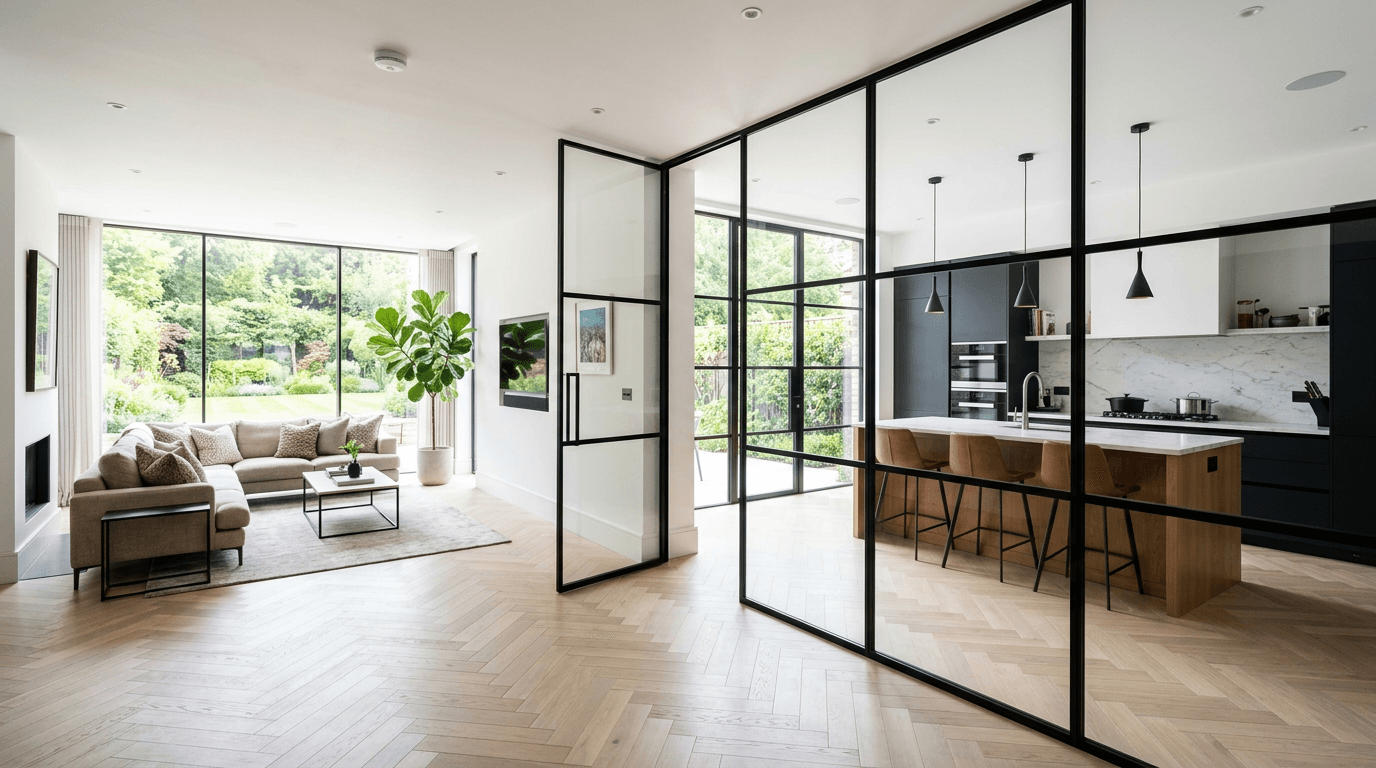
Open Plan Living
The partition that solves everything
Connected spaces. The option of separation. One decision, made in steel and glass.
The Open Plan Paradox
Open when you
want open.
Closed when you
need closed.
The fully open plan home — no walls, no thresholds, one continuous space — has dominated residential design for two decades. It remains the dominant aspiration. But it has a problem that has become more visible in recent years: it cannot be switched off.
Kitchen smells reach the living room. The television is audible from the study. A child's homework cannot happen at the kitchen table while dinner is being prepared. The home office is the dining room is the living room — simultaneously.
A steel frame glass partition is the answer to this problem that does not require choosing between connection and separation. When the doors are open, the space is open. When the doors are closed, the space is divided — acoustically, thermally, and visually — but light still passes, and the rooms still read as connected.
The Three Most Specified Applications
Kitchen / Living Division
The most common application. A double door or door-with-panels at the kitchen-living threshold. Open for entertaining, closed for cooking. The kitchen remains visually present from the living room when closed — the glazing maintains the feeling of connection.
Home Office Partition
Separating a working space from the main living area without building a solid wall. The glazed screen means the office is visible — it reads as part of the house, not as a closed room. When the door is closed, conversation and background noise are significantly reduced.
Playroom / Living Separation
A glazed partition between a children's play space and the main living room allows supervision from one side and containment from the other. The visual connection is total — the children can see the adults and vice versa — while sound and mess stay where they should.
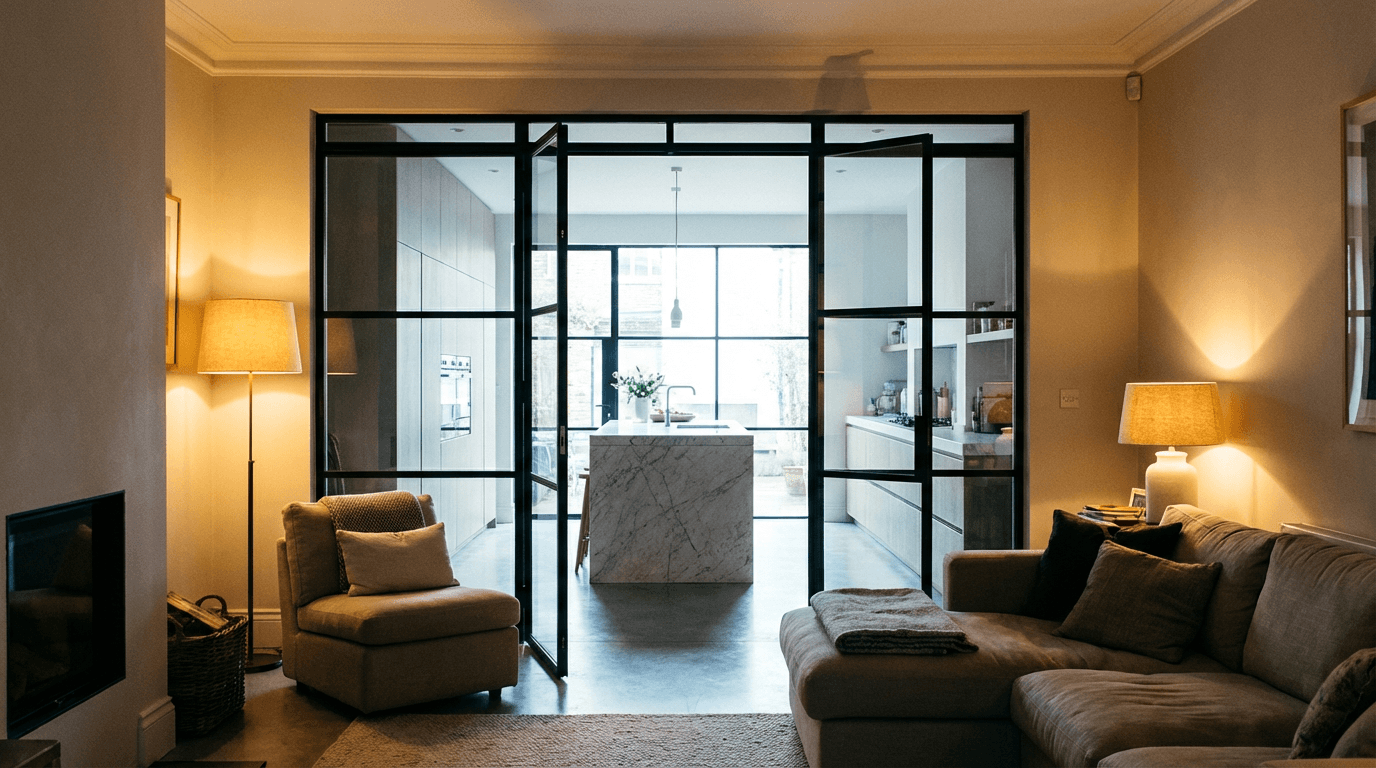
"The space that knows when to be open, and when to close — that is the well-designed home."
TDS Design Notes
Choosing the Right Configuration
The opening
determines the choice
Wide structural opening — 2.4m to 4m+
Double Door + Both Side Panels
The maximum glazed configuration. Two hinged leaves, fixed panels to both sides. When both doors are open and folded back, the opening is completely clear — the space is genuinely open plan. When closed, full separation. Best for kitchen-living divisions in wide extensions.
View configuration →Wide opening — 1.8m to 3m
Single Door + Both Side Panels
A single hinged leaf with fixed panels on both sides. The door is offset to one side, leaving most of the opening permanently glazed. Traffic passes through the door; light passes through everything. Practical for high-frequency use spaces.
View configuration →Standard to medium opening — 1.4m to 2.4m
Double Door
Two equal-width hinged leaves. The doors open in opposite directions, clearing the full opening when both are open. For formal openings between principal rooms — dining room to drawing room, library to hallway.
View configuration →Standard doorway — 750mm to 1.2m
Single Door
The simplest intervention. A single glazed leaf replacing a solid door. For home office partitions, study doors, utility room connections. The full-height glazing transforms the character of the door — and the rooms on both sides.
View configuration →Acoustic Performance
Glass does not mean loud
A well-sealed steel frame glass partition with laminated glass achieves 35–40 dB sound reduction — comparable to a solid internal wall for most residential purposes. Standard float glass provides approximately 28–32 dB.
The door leaf and its sealing system are the most critical factors. A door that does not seal properly will underperform regardless of glass specification. TDS doors are manufactured with continuous perimeter seals.
For home offices and study partitions where acoustic privacy matters, we advise on glass specification during the design consultation and site survey.
Thermal Performance
Zone your home for energy
A steel frame glass partition between the kitchen and living areas allows the two spaces to be thermally zoned — the kitchen, which generates its own heat from cooking, can be separated from the living room which requires controlled heating.
In a rear extension with underfloor heating, closing the partition at night prevents heat loss into the older, less well-insulated original building. The energy saving can be significant over a heating season.
Double glazing is standard in TDS OC Slimline partitions. For maximum thermal performance, we can specify triple glazing or specialist low-emissivity glass.
TDS · Dublin
Made to measure.
Made for your opening.
We visit the site, take the measurements, advise on configuration and glass, and manufacture to the exact opening. No standard sizes. No compromises.
FAQ
What is a steel frame glass partition?
A steel frame glass partition is a fixed or partially openable glazed screen set within a structural opening or non-structural wall position. It typically combines one or more hinged door leaves with fixed glazed panels. The frame is slimline welded steel — 20–25mm visible profile — powder coated in RAL 9005 black or any specified colour. The result is a transparent or translucent room division that maintains visual and light connection while providing acoustic and thermal separation when the doors are closed.
How much acoustic separation does a steel frame glass partition provide?
A well-sealed steel frame glass partition with laminated glass can achieve 35–40 dB sound reduction — comparable to a solid internal wall for most residential purposes. Standard float glass provides less reduction (approximately 28–32 dB). The door leaf and its sealing are the most critical factors; a door that does not seal properly will underperform its glazing specification. TDS doors are manufactured with continuous perimeter seals to maximise acoustic performance.
Can I install a steel frame glass partition in an existing open plan space?
Yes. A steel frame partition can be installed in an existing open plan space by creating a structural opening in an existing wall, or by building a new non-structural partition position. The door frame is manufactured to the exact opening dimension following a site survey. In open plan spaces where no existing wall exists, the partition can be designed as a freestanding screen with a structural steel post, or positioned within a new lightweight framed wall.
What configurations are best for dividing a kitchen from a living room?
For a kitchen-living division, the most effective configuration is a double door with side panels — two hinged leaves meeting at centre, with fixed glazed panels to both sides. This fills a wide structural opening with maximum glass, maintaining the open plan feeling when the doors are open, and providing full separation when closed. For narrower openings, a single door with one side panel provides the same visual quality with a smaller footprint.