EN 1627 vs UL: European and American Security Door Standards Compared
Two certification systems dominate global security door specification: EN 1627 (Europe) and UL standards (United States). They are not interchangeable, they test different things, and knowing which applies to your project can determine whether a door will be accepted — or rejected — by a building authority, insurer, or specifier.
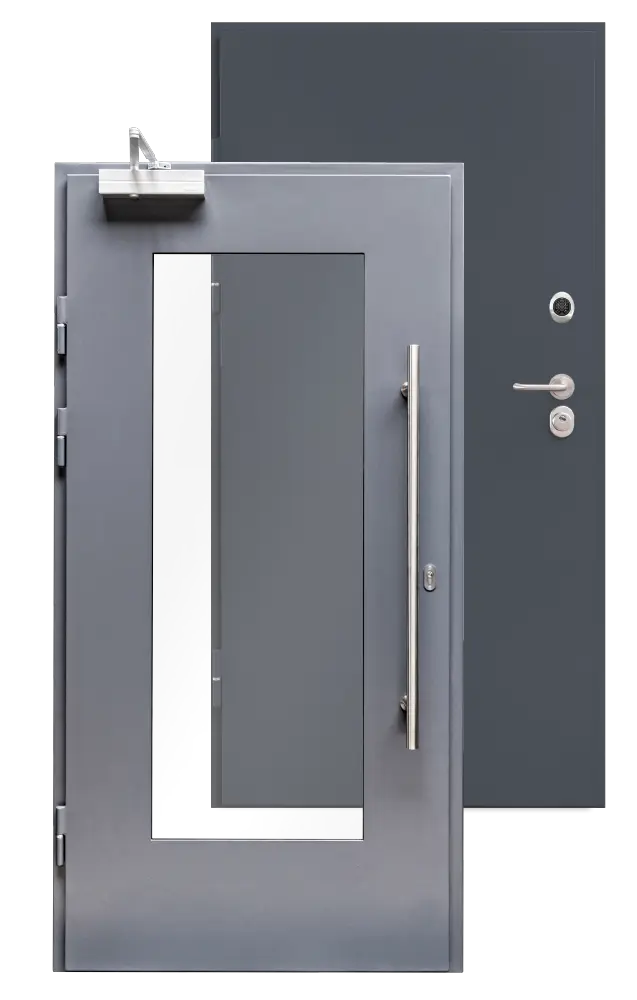
View Our EN 1627 Certified Security Doors
RC2–RC6, FB bulletproof, EI fire-rated and EXR blast-resistant. Supply worldwide.
Related articles
- RC Ratings Explained: RC2 to RC6 — full breakdown of what each class means
- EN 1627 Burglar Resistance Standard — technical specification overview
- EN 1522 Bullet Resistance — FB ratings for ballistic protection
What is EN 1627?
The European standard for burglar-resistant door and window assemblies.
EN 1627 is published by CEN, the European Committee for Standardisation. The current version is EN 1627:2021. It defines requirements and test methods for burglar resistance of building envelope elements — primarily doors, windows, shutters, and curtain walling.
The standard classifies assemblies into six Resistance Classes:
- RC1 — Physical strength only. Resists bodily force (kicking, shouldering). No tool resistance.
- RC2 — Resists a skilled attacker using basic hand tools: crowbars, wedges, hacksaws. Minimum 3-minute attack.
- RC3 — Resists a second set of tools including chisels, hammers, and locksmith tools. Minimum 5-minute attack.
- RC4 — Resists power tools: 650W cordless drill, bolt cutters, angle grinder. Minimum 10-minute attack.
- RC5 — High-powered tools: electric sabre saw, jigsaw, 1,100W angle grinder. Minimum 15-minute attack.
- RC6 — Maximum resistance: 1,050W drill, 2,300W angle grinder with 230mm cutting disc. Minimum 20-minute attack.
A critical feature of EN 1627 is that it tests the complete assembly — door leaf, frame, hinges, locks, and hardware — as a single unit under attack conditions. A door cannot achieve RC4 if its hardware is only RC3-rated. Every component must meet the class requirement.
What are UL Standards for security doors?
American component-level certification, not a door assembly standard.
In the United States, security door hardware is certified primarily through Underwriters Laboratories (UL) — a private, independent testing organisation. UL does not publish a single door assembly standard equivalent to EN 1627. Instead, certification covers individual components:
- UL 437 — High-security lock cylinders. Tests resistance to picking, drilling, and manipulation. Grades: listed or not listed.
- ANSI/BHMA A156.30 — High-security locks and cylinders. Grade 1 (highest) through Grade 3.
- ANSI/SDI 100 — Steel door and frame standard, defining construction grades (Level 1–4) based on gauge and construction quality — not forced-entry resistance.
- UL 10C — Fire door assemblies (not related to burglar resistance).
There is no US standard that tests a complete door assembly (leaf + frame + hardware together) against a timed tool-based attack in the way EN 1627 does. US specifications are typically assembled from multiple component standards rather than a single assembly classification.
EN 1627 vs UL: key differences
| Aspect | EN 1627 (European) | UL / ANSI (American) |
|---|---|---|
| What is tested | Complete door assembly (leaf + frame + hardware) | Individual components (lock, cylinder, door blank) |
| Classification | RC1–RC6 (six classes) | Grade 1/2/3 (per standard); no unified door class |
| Test methodology | Timed attack with defined tool sets by class | Performance criteria per component type |
| Published by | CEN (European Committee for Standardisation) | UL (private), ANSI/BHMA, SDI (industry bodies) |
| Primary markets | EU, UK, Middle East, parts of Asia and Africa | USA, Canada, some Latin American markets |
| Regulatory status | Mandatory reference in many EU building regulations and insurance requirements | Voluntary (required for some insurance/commercial applications) |
| Direct equivalence | None — the systems are not directly comparable | |
Where is each standard recognised?
EN 1627 — Europe, Middle East, and beyond
EN 1627 is the mandatory or referenced standard for burglar-resistant doors in:
- EU member states — referenced in national building regulations across Germany, France, Netherlands, Poland, Ireland, and others
- United Kingdom — adopted as BS EN 1627 post-Brexit; unchanged in substance
- Norway, Switzerland, Iceland — EEA members aligned with EU norms
- UAE (Dubai) — Dubai Municipality references EN 1627 for high-security building specifications
- Saudi Arabia, Qatar, Kuwait, Bahrain, Oman — Gulf states generally follow British/European norms in construction specifications
- Turkey, South Africa, Singapore, Hong Kong — markets with strong European technical influence
UL / ANSI — North America
UL and ANSI standards are the reference point in:
- United States — required for insurance compliance, GSA (government) procurement, and some commercial building codes
- Canada — generally follows UL with some Canadian Standards Association (CSA) additions
- Parts of Latin America — countries with US construction influence
If a project spans both markets, it typically requires independent certification to both EN 1627 and the relevant UL standard — there is no mutual recognition agreement between the two systems.
Why EN 1627 certification has global relevance
One underappreciated aspect of EN 1627 is that it certifies the system, not the brand. A door certified to RC4 under EN 1627 has been physically attacked with an angle grinder for ten minutes and survived. That is a tangible, reproducible result — not a specification claim.
This makes EN 1627 certification particularly persuasive in international procurement for government, military, embassy, and data centre facilities — contexts where specifiers are accountable for their decisions and need a traceable, third-party-verified standard. In contrast, a "Grade 1 lock" in a US specification tells you the lock component was tested; it says nothing about whether the door leaf, frame, or installation will hold under a sustained attack.
For global projects where the client is not in the US market, EN 1627 is typically the more rigorous and more widely recognised specification to hold.
TDS security doors: EN 1627 certifications
All TDS security doors are manufactured and independently certified to EN 1627. Our range covers:
- RC2–RC6 — burglar resistance (EN 1627)
- FB4–FB7 — bullet resistance (EN 1522/EN 1523)
- EI30 / EI60 — fire and smoke resistance (EN 13501-2)
- EXR — air-blast and explosion resistance (EN 13123)
Certifications are issued by accredited EU testing bodies and are accepted in Ireland, the UK, and all markets that reference European standards. We supply worldwide — including the Middle East, where EN 1627 is the relevant standard for high-security door specifications.
We do not supply to the US market, where UL certification would be required and our EU certifications would not be accepted as a direct substitute.
For project-specific documentation — certificates, test reports, section drawings, or specifications for tender — contact our technical team.
EN 1627 Certified Security Doors — Supply Worldwide
RC2–RC6 burglar resistance, FB bulletproof, EI fire-rated, and EXR blast-resistant. Manufactured in the EU. Full certification documentation available on request.